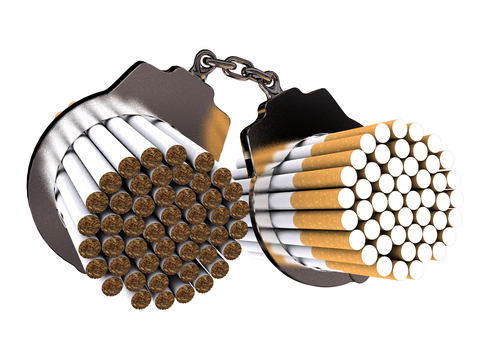
Most people who smoke and/or vape believe that their smoking/vaping is ‘just a habit’ and that they’re not addicted.
Addiction however, is made up of 3 parts:
- the physiological dependency to nicotine
- habitual connections and
- emotional connections
Most smokers and vapers believe that if they wanted to, they could quit at any time. The power of nicotine addiction is often underestimated.
The power of nicotine addiction
It is well established that nicotine is the primary drug in tobacco. It is also now included in electronic cigarattes (vaping devices) and it is the nicotine that causes addiction.
Nicotine is the main reason why people cannot quit.
From the first puff and/or vape, nicotine reaches the brain within 10 seconds, and once it enters the bloodstream, it triggers a number of chemical reactions. In particular, dopamine is released and the user feels alert and content.
Due to the chemical changes in the brain, when the person tries to quit, they experience strong cravings for nicotine. It is often cravings and withdrawal that lead many smokers and vapers back to their full time use.
Still believe that you are not addicted to nicotine? Then answer this quick quiz:
- Do you smoke and/or vape within 30 minutes of waking?
- Do you smoke and/or vape 10 or more cigarettes a day?
- Have you had withdrawal symptoms and/or cravings when you’ve tried to quit in the past?
Have you answered yes to ONE of these questions?
If you have, you would be considered as nicotine dependent. Dependency can also be described as low, medium and high, with highly dependent smokers and vapers finding it harder to quit.
Most smokers and vapers however (if not all), are also closely tied to habitual and emotional triggers. These triggers similarly play a key role in dependency.
The power of habitual connections/triggers
On top of the physiological experience of nicotine, over time users also learn to link their smoking with certain behaviours and habits. Some examples include, smoking/vaping:
- when the phone rings
- with coffee
- when driving
- after lunch
- whilst watching TV
- after work with a glass of wine
Within a short time frame, these habits often become quite established and routine.
The power of emotional connections/triggers
There are also strong connections between how people feel and their use of cigarettes and/or vaping devices; these triggers are considered emotional ones.
Some common examples include, smoking/vaping when:
- bored
- stressed
- angry
- sad
- anxious
- happy
- lonely
Both habits and emotions can trigger an automatic response to smoke/vape. They often go unnoticed, as they are part of the smoker’s/vaper’s coping mechanism or daily ritual. It’s like driving a car home from work or from shopping, without paying attention – it becomes routine and a way of life.
So what can you do?
1. Understand your own smoking and/or vaping behaviour
The key to successfully quitting is to understand your triggers so you can tackle them one at a time and much more effectively.
Think about when you smoke and/or vape. What time is it? What are you doing and with whom? Are you with other friends who are smoking and/or vaping? Do you smoke or vape when you drink or socialise? Do you vape or smoke when you’re bored or angry?
If you’re not sure, keep a daily diary or a cravings record, to help you with this.
Then take a closer look at your triggers and start thinking about what else you could do instead of smoking and/or vaping. We’ve highlighted some useful strategies in another post.
2. Use the quitting medications to help you
Remember that nicotine is a powerful drug; it drives the addiction and is the primary reason why people cannot quit.
If you want to quit and smoke (or vape) first thing in the morning, and/or smoke and/or vape 10 or more cigarettes a day, and/or have struggled to cope with cravings and withdrawal in the past, then the quitting medications can help you.
The quitting medications include nicotine replacement therapy (NRT), bupropion and Champix.
Current NRT products include the patches, nicotine gum and lozenges, as well as the mouth spray. They are available over-the-counter in your local pharmacy, as well as in some supermarkets and petrol stations.
Bupropion and Champix are prescription medications. Speak to your local doctor for further information.
The use of quitting medications are encouraged for people who are nicotine dependent. They can double to triple your chances of stopping successfully compared to a person who quits on their own.
Combine the medications with counselling/support, and it further increases your chance of quitting successfully.
Most people who smoke and/or vape make numerous attempts to quit. With an understanding of addiction, emotions and habitual behaviour (and putting the right strategies in place), and with the use of quitting medications, including receiving some personal counselling and/or support , you too can enjoy a smoke/vapefree and healthy life.
We hope you enjoyed this post and until next time, wish you all great health and wellbeing.
Like this article? Then share it on social media.
Want to be kept up to date? Subscribe to our monthly newsletter and as a thank you gift, receive our health & wellbeing e-Book for free.
REFERENCES
Greenhalgh, EM, Scollo, MM and Winstanley, MH. (2026). Tobacco in Australia: Facts and issues. Melbourne: Cancer Council Victoria.
The Royal Australian College of General Practitioners. Supporting smoking cessation: A guide for health professionals. (2019). 2nd edn. East Melbourne, Vic: RACGP.
US Surgeon General’s Report (2020). Smoking Cessation: A Report of the Surgeon General. U.S. Department of Health and Human Services.